Wednesday, 21 December 2011

Product Placement: Muck Arctic Pro boots

In the continuing tradition of icefishing-related gear reviews, I present Muck Arctic Pros. I icefish a lot, in much colder weather than I used to (my new minimum temp for heading out the door is -35C), and for the past couple of years I've relied on some felt-lined pac boots from Mark's. They're warm, but they've got a couple of serious flaws:
a) they're only waterproof up to about 3" off the ground, which means inevitably they get wet while I'm clearing holes
b) walking in them is like walking around with buckets strapped to my ankles

This year, I decided to find something better. I've like the idea of rubber/neoprene boots, ever since I encountered fishermen wearing insulated XtraTufs on the East Coast, but I'd never found anything that looked quite warm enough. The Arctic Pros, though, seem to fit that niche.


These boots aren't quite as warm as my pac boots, but I'll happily wear them fishing down to -25C. Their main feature, though, is how damn comfortable they are - much more so than regular old rubber boots, and miles above pac boots. They're great to walk in, and in the ~3 months I've had them, they're definitely my first choice for what I wear outside - if I'm going out the door and it's winter, I put these on. So, I'm very pleased. The only thing I'd warn against is using them as a shoulder-season boot - any warmer than -5C, and they're too hot to be pleasant to walk around in (though they'd be great for being stationary at that temperature). Now, if I had unlimited money, I'd get some slightly-less-insulated Mucks for moose hunting - they'd be ideal.

Sunday, 4 December 2011

First Blood

American Thanksgiving in Pincher = Tom's last chance for deer.

Jesse and I headed out first thing Saturday morning - there were a couple of inches of snow from the night before, and there were tracks everywhere. We saw a few groups within an hour or so, but they were all spooked and running so there wasn't much chance of following them.

A bit later we happened upon a doe a few yards away, she ran a few steps and turned around to look at us, but all I could see through my scope was the top half of her head. Not much to shoot at, and I wasn't confident enough to take a head shot, especially from standing. Jesse had a good look at her, so I sidled over to where he was, and I was looking at a good broadside shot about 40 yards away. Of course, being a newbie to this, and having just finished a minute-long staring contest with a doe, I was a little (ok, a lot) jacked up and I was somewhere between "shaky" and "call a doctor, I think he's having a seizure" on the steadiness spectrum. But closer to the former, I swear. At any rate, after what seemed like a really long time but was probably only 7 or 8 seconds, she huffed, waved goodbye with her tail, and was gone. Curses.

But we'd already seen 5 deer in not much over an hour - surely there would be more chances, right?

We continued roaming around, with a good headwind to keep our scent away. We found a nice set of tracks, with fresh urine in a couple of spots, and followed for several hundred yards, but didn't find anything before losing the tracks in a stand of trees. We ended up just following a trail a little aimlessly, slowly meandering back toward the house for breakfast, when two deer flushed out of the trees a little bit ahead of us and stopped about 20 yards off the trail. I could only see one from the trail, a small doe, and it looked like I'd have a good sightline at another broadside shot a few steps off the trail from about 50 or so yards. No waiting this time; I took a few steps, dropped down, lined up, bang. The deer jumped and ran, but I was sure it was a hit.

Yup.

Finding this made Jesse really excited. But maybe not as excited as the half-dozen elk that ran past us as we were following the blood trail. Jesse! Stay focussed! We have a deer to find! We followed the blood trail for 30 or 40 yards, and saw the deer in a heap. Not a small doe, but a fawn buck. I'd missed the lungs by a couple of inches to the right. Shit. I felt really bad about it, but at least we were able to find and put him down quickly.

After a quick (but smelly/rumen-y) gutting lesson from Jesse, we started dragging him the couple of km or so back to the house to hang him in the shed.

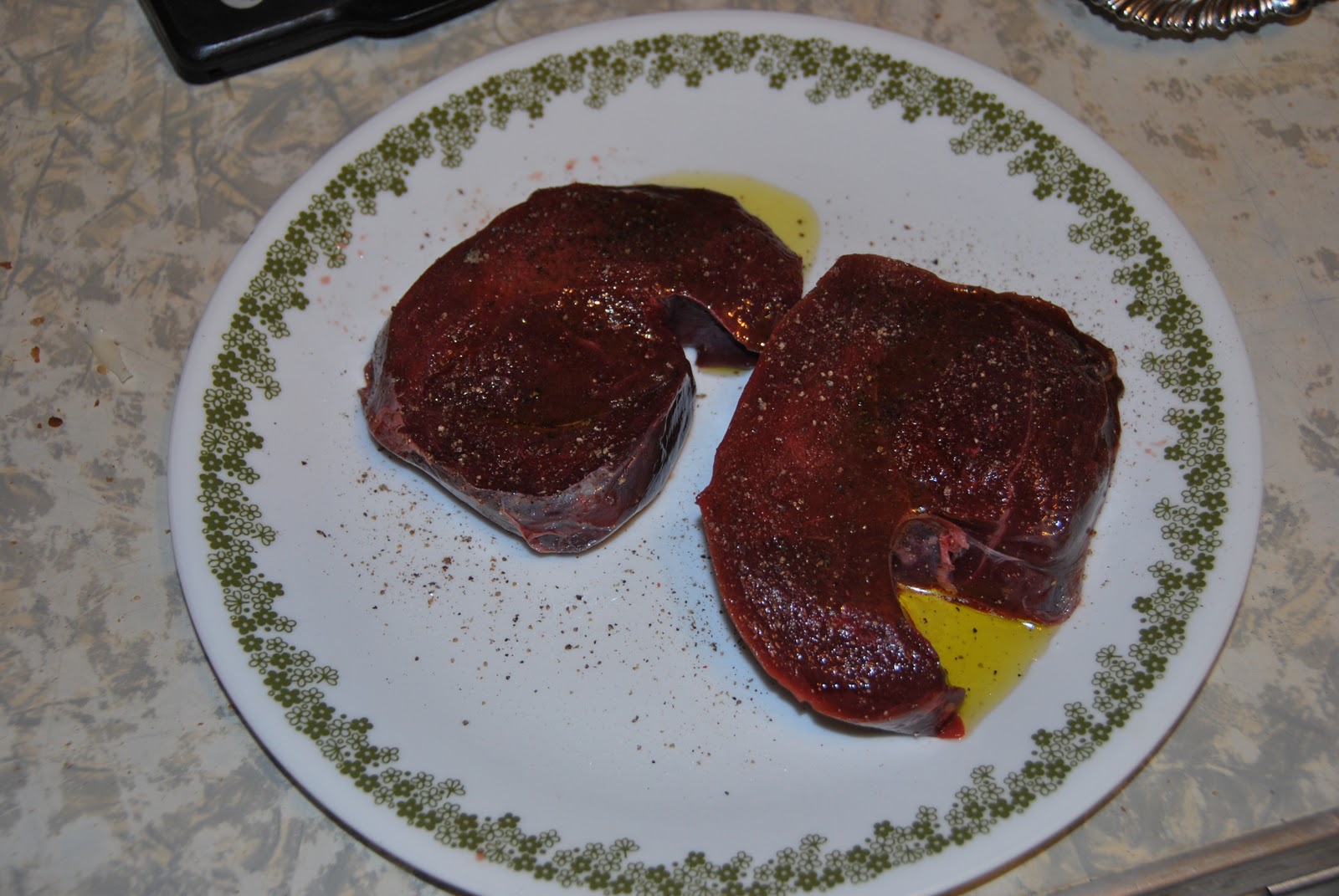
First thing's first: mining for tenderloins.

Mission accomplished.

Breakfast of champions. (Not pictured: victory shots of bourbon. Which, for the record, pairs nicely with seared tenderloin, even especially at 11 AM)

Apparently Otis, that bloodthirsty carnivore, was jealous of the fresh meat and decided to get some of his own:

Lessons for next year:

1. Hunting for deer in Pincher seems like a good bet, based on how many we saw and how relatively un-skittish they were. It was definitely more enjoyable than the previous weekend I'd gone out west of Edmonton, but having the flu might have had something to do with that unpleasantness. So I guess that makes lesson #2 "don't sit outside in -10 weather when you have the flu." I was probably really quiet, though, if only because I was only semi-conscious.

3. Practise shooting more. My shot wasn't off by a ton, but on a small target like a fawn it was definitely off by enough.

4. Don't shoot anything bigger than a fawn if you drive a Versa hatchback. I really wish I'd taken a picture of the back of the car. It was kind of awesome.

Tuesday, 15 November 2011

Tom Yum Lota

After my recent salmon head soup experience, I was eager to try it again. A nice big burbot I caught this Sunday (Dezadeash Lake is awesome) gave me the opportunity. Tom Yum!

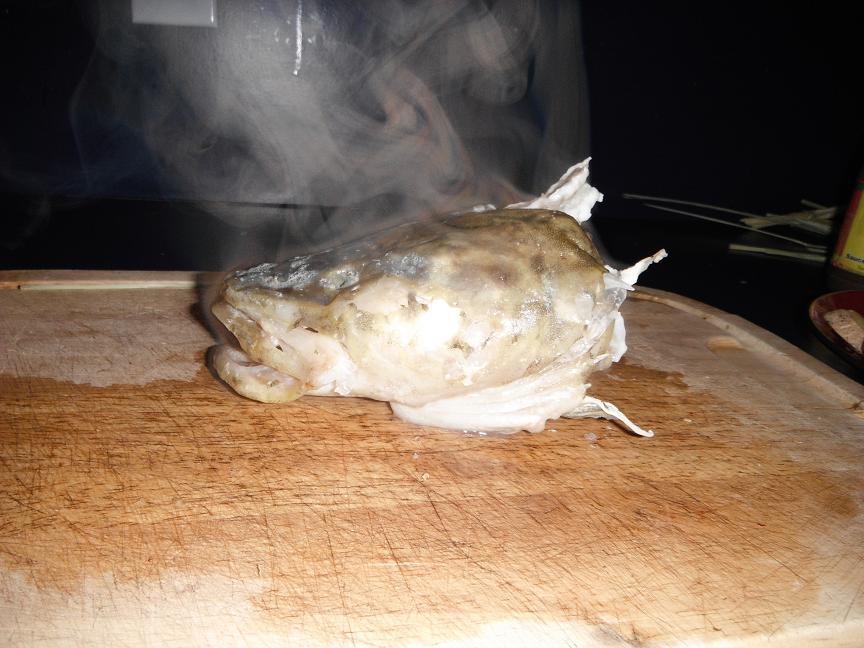
Shiny new pot, full of a burbot

If this were eXistenZ, I could turn this into a gun

I simmered the burbot head and rack for 20 minutes, then broke them down to edible parts and set them aside.

Less meat here than you might expect

Then, I added the other ingredients (except the lime and burbot belly) for another 20 minutes in the broth. Not pictured, but added, were lime leaves and straw mushrooms.

I need better lighting in my kitchen

I cut the belly into strips, popped them in the simmering broth for a minute, then tossed in the reserved meat, added some more fish sauce, and added lots of lime juice.

Not as surprising as salmon head soup, but entirely edible

If I had a bottle of Chang, were sitting in a plastic lawn chair, there were geckos on the wall, and the air smelled vaguely of wet towel, this would be pretty Thai.

Monday, 7 November 2011

Chasing silver in SE AK

The only thing to do during the transition period between open water and frozen lakes, of course, is to go fishing elsewhere. Todd (who you met in the moose hunt post) and I took a long weekend in Haines two weeks ago, looking to hit the end of the coho run on the Chilkat. The peak of things tends to be around Thanksgiving, but that also tends to be when Haines and the Chilkat are overrun with drunk Canadians flinging pixies. We hoped to avoid the crowds, but still get into fish.

Chilkat River

There's a lot about salmon fishing I don't know. The Chilkat is a biggish, brownish, braided river, so there's lots of water and it's tricky to read. Salmon don't really act like stream-resident fish (I don't think), and they're not feeding anyway, so you're chasing unusual fish that take some special voodoo to make bite. My understanding of coho is that they tend to hang out in slower-moving pools, and that they're most likely to bite when your fly is moving quickly and they're coaxed into chasing it. Another feature of the Chikat, that's either a blessing or a curse, depending on how you feel about it, is that it's got a healthy run of chum salmon, concurrent with coho.

We started in an upriver spot, that we'd had good reports on from a friend of a friend. It was packed with salmon, but they were all chum, and they all looked pretty much like this:

Senescent salmon

After a bit of scouting, we managed to spot a couple of silvery-looking fish in amongst a mass of scuzzy chum, and took turns swinging flies at specific fish. It was a pretty useful exercise - I'd stand downstream of Todd and watch the fly and the fish while he swung through the school - it gave me a better understanding of how flies swing and how fish react to them. After a bit of work, we each managed to hook the fish we were looking at, but they weren't quite as silvery as they'd looked in the water.

May not be good to eat, but they've got great patterns

After a few chum, we headed further downstream in search of coho (or, at least, fresher chum). We stopped for the evening at the closest run to the estuary, and got into good numbers of fresh chum, a couple of which Todd kept. They were pretty silver, but the flesh was already starting to get soft - they'll be edible, I'm sure, but I wouldn't keep any chum less fresh than these:


An eater (depending on who you ask)


Bright chum

It's impressive how much more of a fight you get out of fresh fish - you tend to be able to call how long a fish has been in the river before you can even see it, by how much line it's taking. These silver chum fought pretty well.

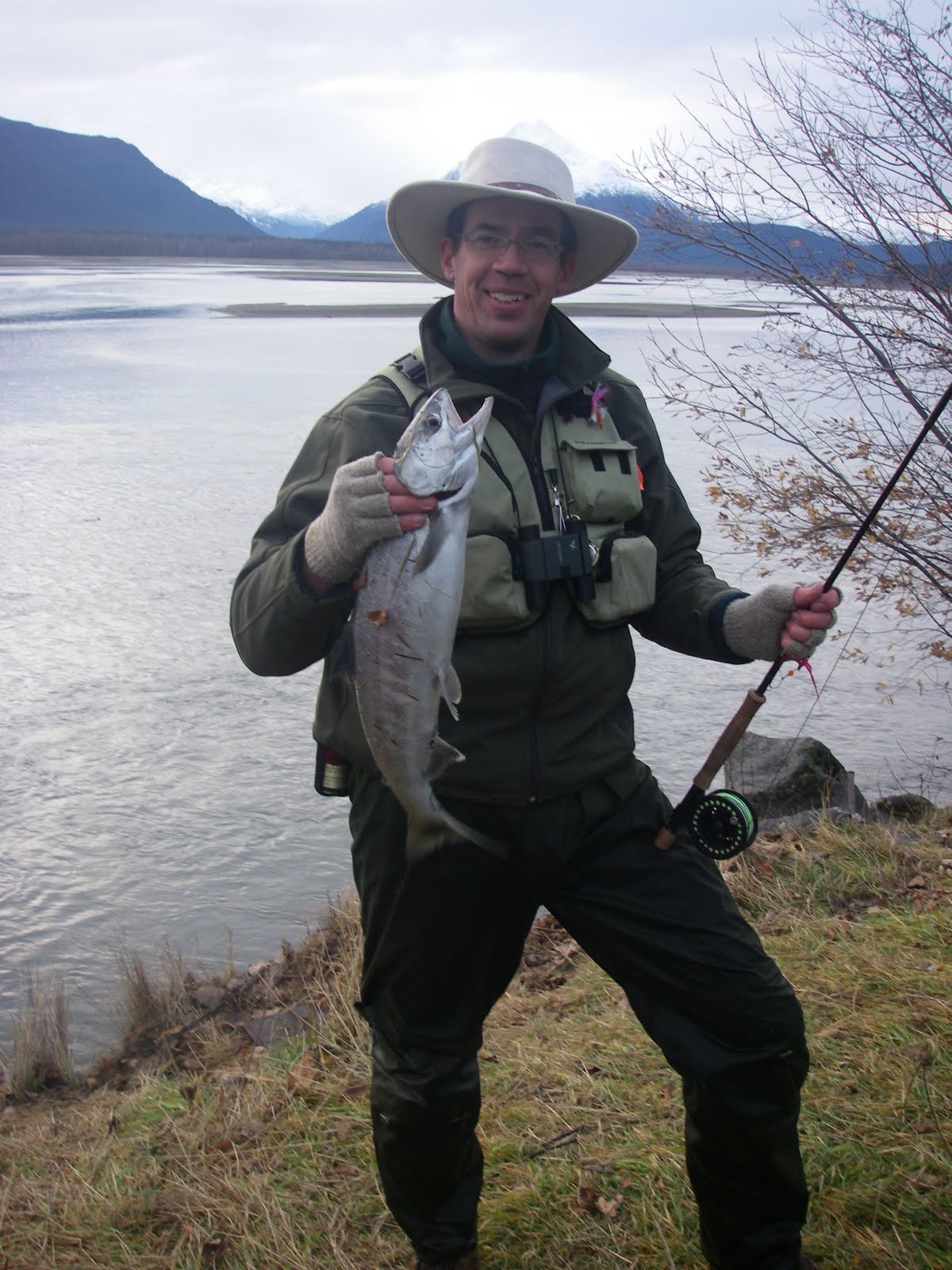
The next day was rainy, cold and windy as hell. Out in the main river flats, casting even with my 8/9 switch was useless. Back at the downstream run we'd worked the night before, we concentrated on little troughs of slow current close to shore, in the lee of shoreline forest. Almost right away, I got into a fish that took line so fast I skinned my knuckles on the reel handle while trying to get hold of it. After a great fight - success, a bright coho buck.

Kisutch!

Almost immediately afterward, I hooked and landed a slightly darker jack coho, and Todd snagged a big bright hen in the tail. Much consternation at having missed the opportunity to fairly hook (and consequently, keep) this fish.


Todd is less pleased than he looks

After that, nothing more on the coho front. I suspect it was a small pulse of fresh fish in from the salt, from which we picked off a few as they passed by. The two that I caught certainly kept to the coho wisdom I'd been given - they were in slow water, and hit a (big pink) fly as I was actively stripping it in. I've got a good recipe for coho flies, by the way, which I'm looking to modify for steelhead use - they look incredible when they're swimming, and they swing really nicely (and nearly every fish we caught the first two days was on the pink version). Another post.

The last day, we slowly worked our way upriver as we headed toward the pass and Yukon. Well upriver, we found a clear pool packed with coho and Dolly Varden, which were too irresistable to pass up (despite being pretty dark). Fish like this are fun to look at, but not to eat - after catching a few, we left them be. I tried, and failed, to catch one of the (really quite big) Dollies.

More where this one came from

Overall, a good trip, though I'd try earlier next year to catch the bulk of the run. The river was deserted while we were there, I could probably put up with a few more people for a few more fish.

So, what to do with a bright Chilkat coho? Salmon head soup!


I need to clean my counter

This is really good.

Saturday, 5 November 2011

Transition period

The transition from open-water fishing to icefishing is always an impatient time for me. This year, though, I managed to reduce it to about its minimum.

Scout Lake - 23 Oct
22" x 12" rainbow

Fish Lake - 5 November
29" x 13" lake trout

Tuesday, 1 November 2011

Product review: knife sharpening kit


Our household knives are dull. My hunting knives are the epitome of dull. (This is where I normally would put in some definition-dictionary joke: but I will refrain). Just know that it would require effort to draw blood from flesh in their current condition.

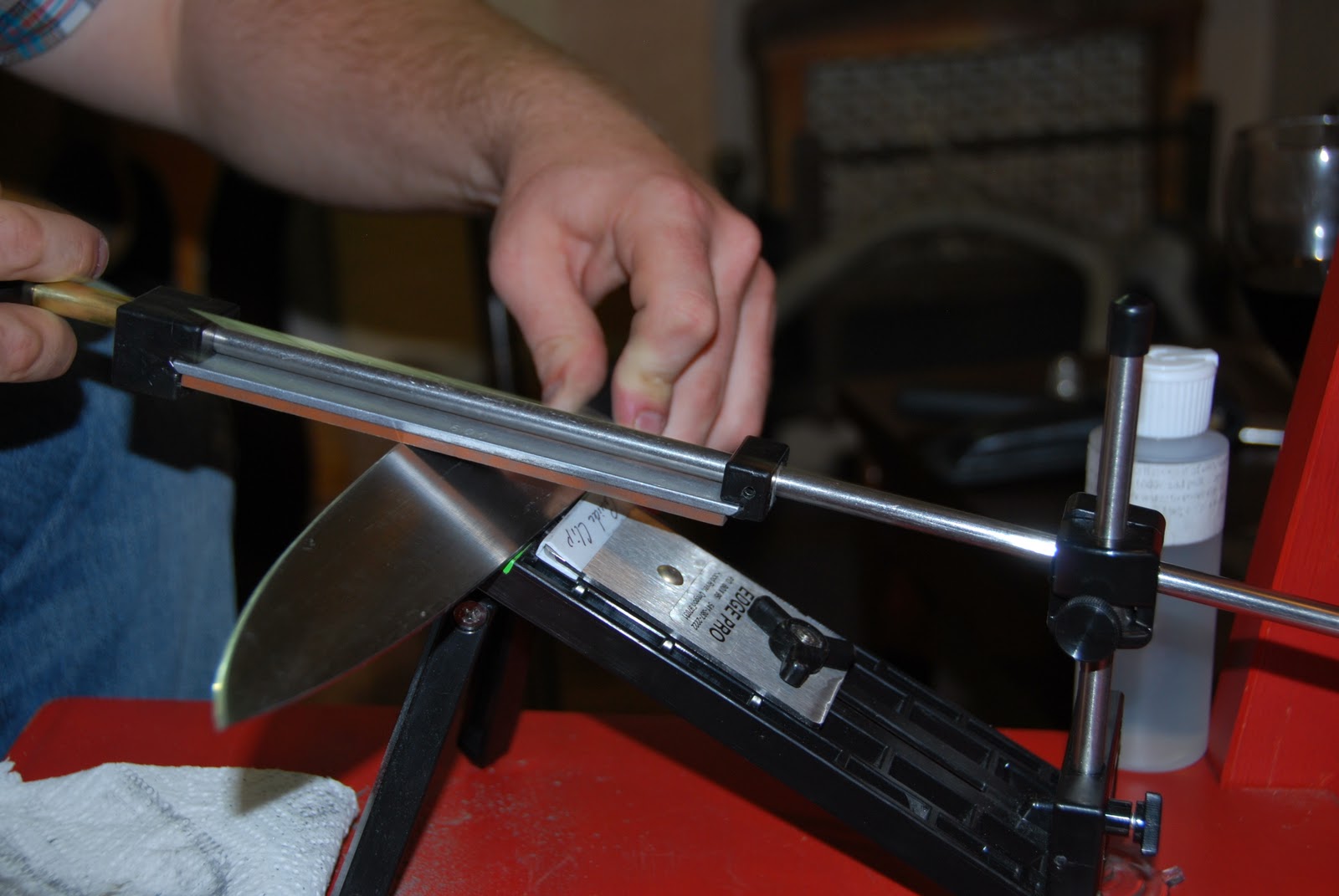
For a month Kim and I have been looking for places to get our knives sharpened. On the interweb there are more cautionary tales than recommendations making it difficult to find a reputable place in Edmonton. Then as luck would have it, Jeremy (an alumni of Kim's lab) was visiting from California and has been sharpening knives as a hobby for the past couple years. The above kit is his.

Accordingly, a venison dinner - knife sharpening transaction ensued.


Jeremy's kit was ~$275, but there are a variety online for as low as $100. They come with a series of stones and can do all the necessary angles. I am sold on it, or at least the idea. You will likely save money in lifetime sharpening costs, have really f**king sharp knives (I already cut myself), and be able to sharpen knives in exchange for beer + food. Jeremy made it look easy and our knives were as good as new.

On a secondary product placement note, my Gerber took an edge way better than my Buck knife.